In advance of COP28, energy companies have
invested significant amounts in social media advertising,
touting their purported efforts towards reducing emissions and advancing transition towards clean and sustainable energy sources.
A key feature of these efforts has been the promotion of biogas, a fuel produced through the controlled decomposition of organic matter such as food waste. In a
notable example
of industry promoting the development of this technology, TotalEnergies, a French energy company heavily invested in oil and gas projects, ran
two advertisements
earlier this year at a cost of €10,000-15,000 each. Both advertisements told the adverts’ audiences, ““#Biogas is a renewable and carbon-free energy that recycles our organic waste. This is why we intend to develop its production in the years to come.”
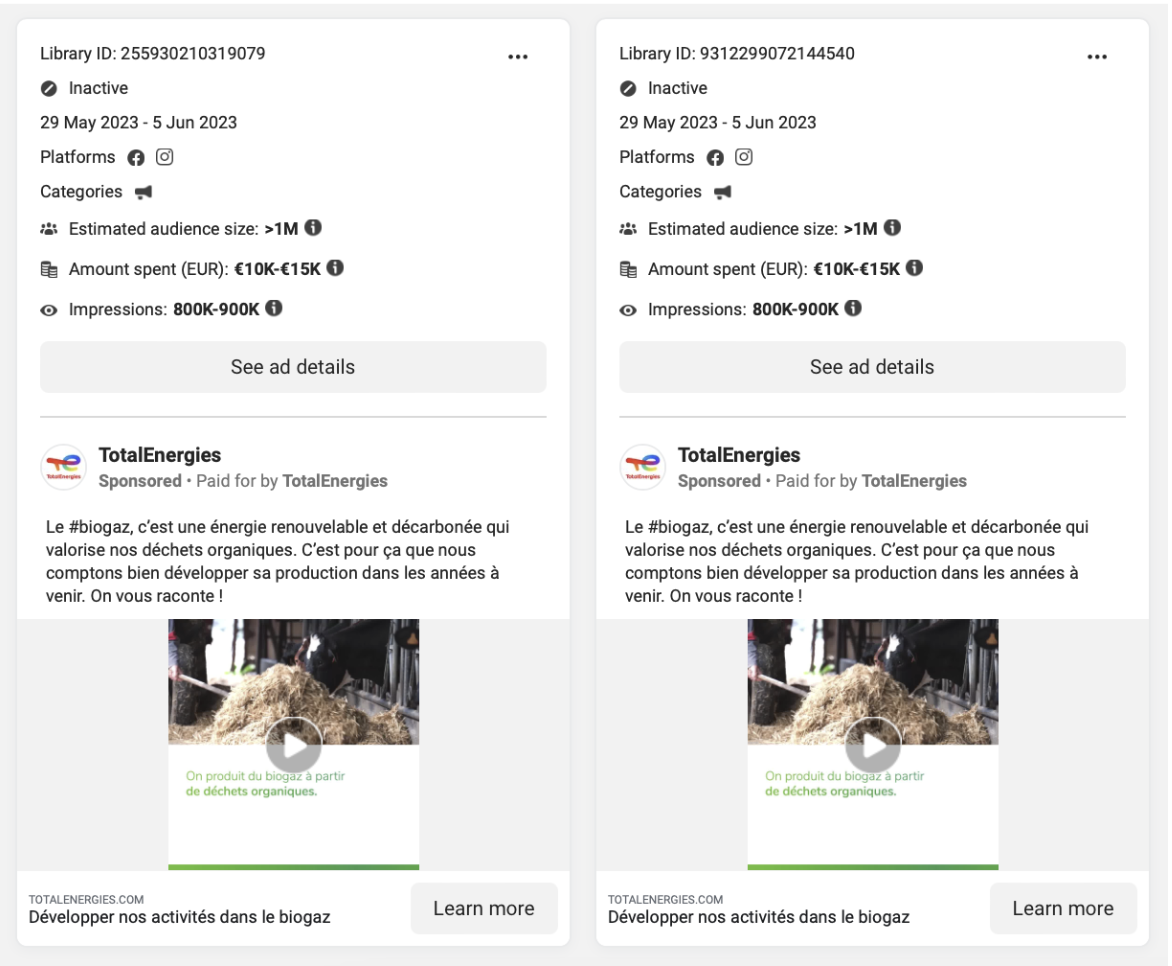
Advertisements placed on Facebook and Instagram touting biogas, paid for byTotalEnergies
Enthusiasm for biogas has not been limited to private companies. Earlier this year, the EU set an
ambitious target
of producing 35 billion cubic meters of biomethane, a form of biogas, annually by 2030, a significant increase from the
4 billion
cubic meters produced in 2022.
Having been embraced by the private sector and governments, it is perhaps unsurprising that the World Biogas Association appears optimistic about technology’s potential as a potent tool in the fight against climate change, going so far as to
claim
that it has the potential to “reduce global emissions by 18-20%.” As the technology is
set to enter the spotlight during COP28,
it is worth considering whether this framing stands up to scrutiny.
Shaky figures inflate biogas’s potential to reduce emissions
When searching for details on the potential of biogas as a means to tackle human-made climate change, the 18-20% figure offered by the World Biogas Association is continually cited. While it may be initially unclear to a casual reader where this figure originates, a footnote included in a
2018 report
published by the body sheds more light, stating, “Fossil fuel combustion for energy accounts for 68% of total greenhouse gas emissions. Coal is 45% of the fossil fuel combustion for energy. So coal is over 30% of emissions given that coal has higher emissions per unit of energy produced than fuels such as natural gas.”
The report claims: “If biogas displaced 60% of coal emissions, it would reduce global emissions by 18%. Biogas also reduces methane emissions from waste and manure management.”
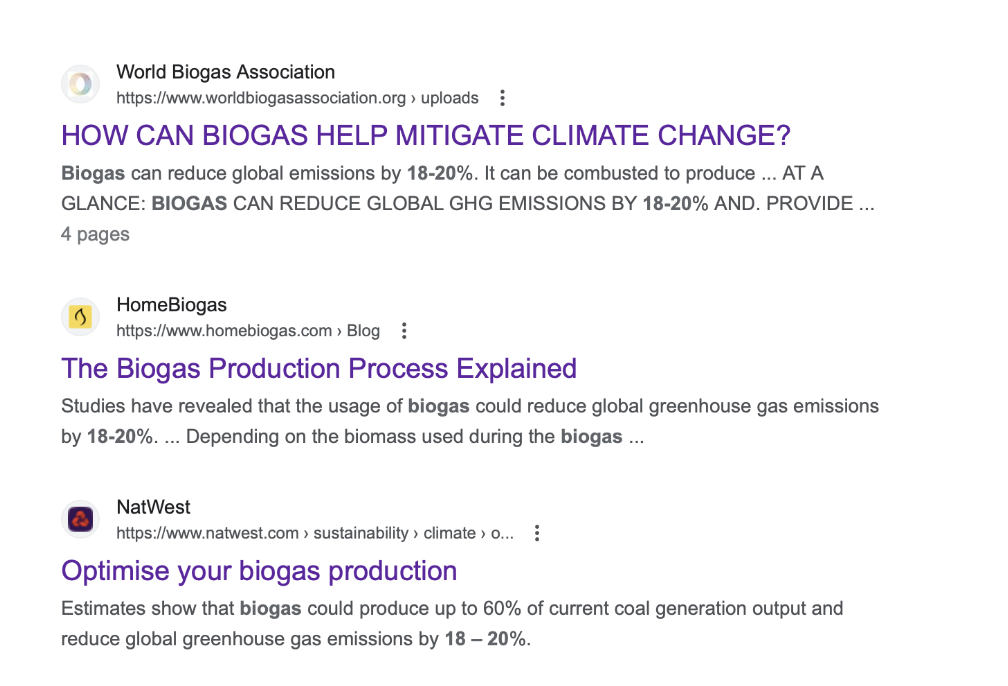
Examples of organizations citing the claim that biogas has the potential to reduce global emissions by 18-20%.
While this appears to be promising, there are numerous issues with these estimates. The first of these concerns the study cited by the World Biogas Association to support the assumption that biogas has the potential to replace 60% of coal emissions.
As made clear in a footnote,
this figure is based on data included in a 2015
paper
published in the journal Energy and Environmental Science entitled “The potential of CAM crops as a globally significant bioenergy resource: moving from ‘fuel or food’ to ‘fuel and more food.”
The primary problem with using this study for this purpose is that it does not describe current production of biogas. Instead, it “examines the potential of plants that use the mode of photosynthesis known as crassulacean acid metabolism (CAM) to generate globally significant quantities of renewable electricity without displacing productive agriculture and perhaps even increasing food supply.”
Summarizing their findings, the authors of this study state, “The data suggests that 5 PW h [petawatt hour] of electricity per year could be generated from CAM plants cultivated on between 100 and 380 million hectares of semi-arid land.” Crucially, this is not a concrete projection based on current – or even planned – production efforts.
Through tracing where these figures originated, it is clear that when the World Biogas Association claims, “the potential for biogas generation, including from CAM crops, is 5.5 PWhe [petawatt hours of electricity produced],” – the amount they state would be needed to displace 60% of coal emissions – a full 5PWhe of this total figure is based on the findings of a paper that does not describe current modes of production.
It should also be noted that, even if biogas production and utilization were to reach the levels cited by World Biogas Association, this would not necessarily entail a 60% reduction in coal emissions without a global, purposeful phasing out of coal use.
Limited effect of best case scenarios
A second figure that is routinely cited is that biogas has the potential to replace 20% of the world's demand for natural gas, a highly polluting source of energy due to the occurrence of methane – a highly potent greenhouse gas – leaks throughout the supply chain.
While this claim, derived from a
2020 report
produced by the International Energy Agency, is more grounded than others, it is important to note that it reflects a
highly optimistic scenario,
according to the Climate Council, an evidence-based organization on climate science in Australia. Put otherwise, even if biogas production and use were to be developed intensely, it would still satiate a very limited proportion of the overall global energy demand.
As an alternate source of energy, the production of biogas does offer serious environmental benefits.
According to the Environmental and Energy Study Institute
– an American bipartisan nonprofit dedicated to promoting environmentally beneficial practices – these range from reducing CO2 emissions from organic waste, providing an alternative to fossil fuels in energy production and reducing dangers to groundwater posed by other forms of waste processing. That being said, a number of factors mean the technology is not the silver bullet its advocates often frame it as.
According to
Zero Carbon Analytics,
a research group focused on the analysis of energy transition policies, issues relating to biogas as an alternative to fossil fuels include high capital costs, reliance on subsidies, limited capacity, and the occurrence of leaks during production, storage, and transportation. Taken together, such difficulties draw into question the technology’s potential as a large-scale solution, to the point that Zero Carbon Analytics advises, “Reliance on biogas and biomethane as a decarbonisation solution should be limited to hard-to-abate sectors where there are currently no feasible, economic alternatives for emissions reduction.”