In Memory of Lebanese Journalist and Fact-Checker Alaa Salman
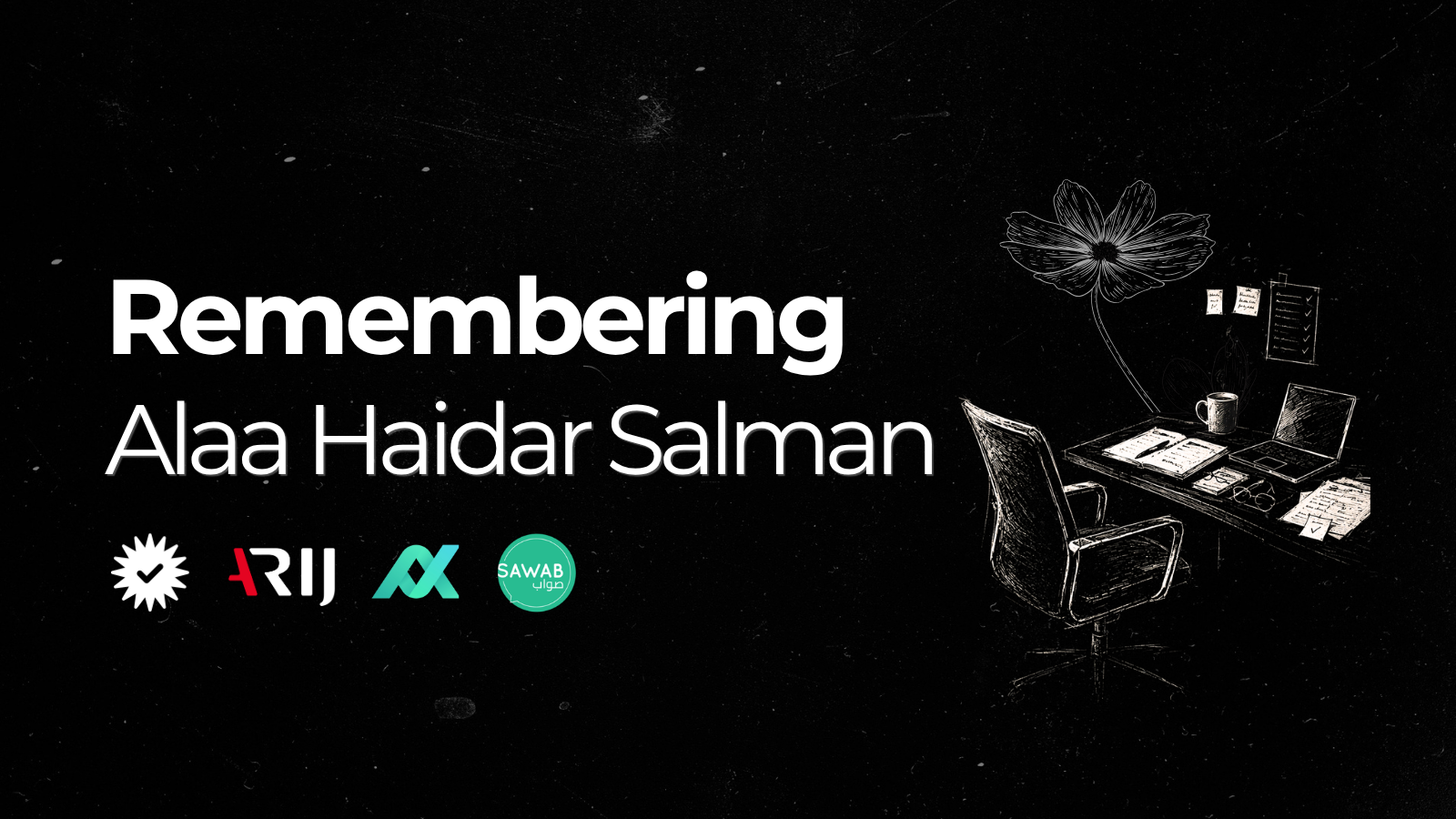
Alaa Haidar Salman was a young Lebanese journalist and fact-checker working with Sawab, a fact-checking organization in Lebanon. She was killed when an Israeli airstrike hit her family’s home in May 2026.
Born on March 16, 2006, in Maarakeh, a town in the Tyre district of southern Lebanon, Alaa was remembered by everyone who knew her for her intelligence, quiet strength, and deep sense of responsibility. Family and friends often turned to her whenever they needed advice or support.
“I will never forget how supportive Alaa was through every stage of my life,” recalls her university friend Fatima. “Whenever I needed her, she was there for me, and she taught me the importance of being responsible.” Her sister Esraa describes her as “loyal, virtuous, kind, calm, compassionate, ambitious, and full of dreams,” adding, “Words are simply not enough to describe who she was.“
Personal Life and Passion for Reading
Family was at the center of Alaa’s life. She helped her siblings with their schoolwork, cared for her grandmother alongside her cousins, and devoted every Thursday to spending time with her. Those who knew Alaa remember someone who made everyone around her feel valued through her kindness, humility, and compassion. “Alaa was the most precious person in my life,” Esraa says. “I always told her that she succeeded in everything she did and that God would always protect her. She would simply smile shyly.” Her university friend Mariam remembers her as “far more mature than her age, calm, and exceptionally thoughtful. Every conversation with her revealed the depth of her perspective on life.“
Reading was Alaa’s greatest passion. She was rarely seen commuting to university without a book in her hands. Among her favorite novels were Agatha Christie’s “And Then There Were None” and Khaled Hosseini’s “The Kite Runner” and “A Thousand Splendid Suns”. Her love for literature extended beyond reading. Two of her own articles were published in PU Times, the student magazine at Phoenicia University.
She had a particular passion for languages, especially Arabic, and dreamed of studying Arabic Literature after completing her undergraduate degree. A devoted football fan, she supported Portugal and greatly admired Cristiano Ronaldo. She also loved nature and enjoyed photographing flowers—a passion reflected throughout her Instagram account.
Education and Academic Excellence
Academic excellence defined Alaa’s educational journey. She ranked first nationwide in Lebanon’s secondary school examinations in 2023, and remained on the university Honor List throughout her studies. As Vice President of the Communication and Social Media Society at Phoenicia University, she helped organize student activities and events. “Her writing was truly remarkable,” Esraa recalls. “Whenever she agreed to read something to me, I was always excited. In fact, Alaa was the one who encouraged me to read, and it became one of my favorite habits.“
Journalism Career
Alongside her studies, Alaa gave private lessons, managed the social media presence of a psychological counseling page, and began her journalism career through an internship at Sawab. She quickly became an integral member of the newsroom. Her colleague at Sawab Fouad remembers her as “one of Sawab’s best writers. I will always remember every question she asked, every effort she made, and all the dedication she showed. Sawab will never be the same without you, Alaa.“
Faith and Personal Values
Faith shaped every aspect of Alaa’s life. She prayed regularly, fasted during the months of Rajab, Sha’ban, and Ramadan, and completed courses in Quran recitation, tajweed, memorization, and Quranic interpretation. Her favorite chapter of the Quran was Surah Maryam. Even during the most difficult days of the war, she completed a Quran tafsir course and earned her certificate.
Cherished Memories
Those closest to her continue to carry her memory. Esraa remembers not only a sister but also her closest companion. “After the dawn prayer, Alaa, my mother, and I would sit together for hours. I miss that routine so much. Throughout the war, all she thought about was how to help our family. While she was in the hospital, I wrote letters to give her once she recovered, but that day never came. She was not only my sister—she was my best friend, my soul, and my safe place.“
Mariam recalls that throughout the war, Alaa refused to leave southern Lebanon despite the danger. “She always said, ‘If we all leave, who will stay?’” Their final conversation took place on the day her home was struck. “We were joking about her upcoming exam. The messages I sent afterward never reached her. I will carry this pain for the rest of my life.“
Fatima remembers a friendship that began on the first day of university and never faded. “She taught me responsibility simply by the example she set. I had prepared a special birthday gift for her, but I never had the chance to give it to her. Alaa was a truly beautiful soul, and she will live in my heart forever.”
Dana, another close friend, says Alaa deeply believed that the people of southern Lebanon should be the ones telling their own stories. “She taught me not to judge people too quickly, but to give them a chance first. Even during the war, she constantly made jokes to ease our anxiety. My favorite memories are our conversations in the university prayer room, where we shared our dreams. Although something will always feel missing without her, knowing that she is at peace brings me comfort.“
Broader Tragedy and Call to Action
Alaa’s death is part of a much broader tragedy facing journalists in Lebanon. According to Lebanon’s Ministry of Public Health Emergency Operations Center, between March 2 and July 1, 2026, Israeli attacks on Lebanon killed 4,297 people and injured 12,196 others. The United Nations Population Fund (UNFPA) estimates that approximately 1.4 million people—more than 20 percent of Lebanon’s population—have been displaced, including around 16,000 pregnant women facing increasing barriers to healthcare and protection. According to Lebanon’s Ministry of Social Affairs, the current ceasefire has allowed until early July 2026, approximately 400,000 people to return to their homes.
The war has also taken a devastating toll on the country’s media community. According to the Committee to Protect Journalists (CPJ), at least 16 Lebanese journalists have been killed in Israeli attacks since the war began in October 2023, including reporters Fatima Ftouni and Ali Shoeib on March 28, 2026, and journalist Amal Khalil on April 22, 2026.
Reflecting on these losses, Rawan Damen, ARIJ Director General, said: “Israel has targeted journalists in Palestine and Lebanon for decades, but over the past 30 months this targeting has become widespread and systematic. It must end immediately. Expressions of sympathy and condolences are no longer enough. Journalists around the world must unite to declare that we do not accept the targeting of our colleagues. This should be the number one priority for every media organization. If we fail to raise our collective voice, we risk setting a dangerous precedent. Other states and non-state actors will see that journalists can be killed without accountability and conclude that there are no consequences.”